VitaLonga

Desk

News archive

Every story stays here. Filter by topic, search older headlines, and save favorites to your member record. Educational notes only — not medical advice.

Saved (sign in)

93 stories in this category

University of Reading / Nutrition Research · 7 Oct 2026 · Nutrition

A review of 22 studies found natural dairy trans fats were not tied to heart disease or type 2 diabetes

Study (review of trials and cohorts). ScienceDaily carried the University of Reading account on 7 October 2026. Constance Gayet-Boyer, Fanny Tenenhaus-Aziza, Moises Torres-Gonzalez, D. Ian Givens, and Cindy Schweitzer report in Nutrition Research (2026; 150:33; doi 10.1016/j.nutres.2026.03.009). They separated trans fats that occur in milk, butter, yogurt, and cheese from industrial trans fats made by partial hydrogenation. Ten controlled trials compared dairy with higher natural trans fat (about 1.3 to 13.2 grams a day) with ordinary dairy and found no meaningful difference in blood lipids. Twelve cohort studies, some longer than 20 years, in Europe, Canada, and the United States, did not link higher blood levels of dairy trans fats with heart disease, stroke, cardiovascular death, or type 2 diabetes. Givens said these dairy fats are not the same as industrial partially hydrogenated fats, and that the finding is about dairy inside a balanced diet, not a reason to seek out trans fat. The release does not split results by sex or age. Educational notes. This is not medical advice.

Read at University of Reading / Nutrition Research →Our summary♡ Save

  • Cardiovascular / lipids
  • Metabolic / glucose
  • Nutrition
  • study

Massachusetts Institute of Technology / Nature · 5 Oct 2026 · Nutrition

A ketogenic diet increased small-intestinal tumors in cancer-prone mice and reduced tumors in the colon

Study (mice genetically predisposed to intestinal cancer). ScienceDaily carried the MIT account on 5 October 2026. Jessica Shay, Fangtao Chi, Omer Yilmaz, and colleagues report in Nature (2026; 656(8127):474; doi 10.1038/s41586-026-10779-y). Mice on a ketogenic diet developed small-intestinal tumors more often than mice on a control diet, at rates similar to or higher than mice on a high-fat, high-calorie diet, without the keto group becoming obese. The increase was traced to intestinal stem cells burning dietary fat, which switched on PPAR proteins and made the stem cells divide faster, not to ketone bodies such as beta-hydroxybutyrate. In the colon, the same diet suppressed tumors, and again ketones were not the driver. The authors say ketone drinks would not be expected to reproduce either effect. The release does not give animal counts. These are mouse findings in a cancer-prone strain, not a human diet trial. Educational notes. This is not a reason to start or stop a ketogenic diet.

Read at Massachusetts Institute of Technology / Nature →Our summary♡ Save

  • Metabolic / glucose
  • Cancer
  • Nutrition
  • study

Queen Mary University of London / Nature Metabolism · 5 Oct 2026 · Nutrition

In 12 healthy volunteers, a seven-day water fast shifted thousands of blood proteins after about day three

Study (12 healthy volunteers; water only for seven days). ScienceDaily carried the Queen Mary University of London account on 5 October 2026. The journal paper is older than that news date: Maik Pietzner, Claudia Langenberg, and colleagues, Nature Metabolism (2024; 6(4):764; doi 10.1038/s42255-024-01008-9), with the Norwegian School of Sports Sciences. About 3,000 blood proteins were measured before, during, and after the fast. The body shifted from glucose toward stored fat over the first two or three days. Participants lost an average of 5.7 kilograms from fat and lean tissue. Three days after eating resumed, weight was still down, most of the lost lean mass had returned, and the fat loss remained. About one third of measured proteins changed, with a coordinated shift after about three days that the authors say was not explained by weight loss alone, including proteins tied to support around neurons. The release does not give sex or age. Langenberg said the wider changes were visible only after three days of total calorie restriction, so shorter intermittent fasts are not shown to do the same thing. This is not a plan to stop eating. Educational notes. This is not medical advice.

Read at Queen Mary University of London / Nature Metabolism →Our summary♡ Save

  • Metabolic / glucose
  • Nutrition
  • study

Frontiers in Aging · 2 Oct 2026 · Nutrition

Association between tooth retention and lower inflammatory dietary pattern in older adults

IntroductionTooth loss is highly prevalent among older adults and may compromise food selection, diet quality, and adherence to proinflammatory dietary patterns, thereby contributing to chronic inflammation and adverse health outcomes. This study investigated the association between tooth retention and the inflammatory potential of the diet among older adults.MethodsA cross-sectional analysis was conducted among 1,07

Read at Frontiers in Aging →Our summary♡ Save

  • 60+
  • Nutrition
  • Aging
  • original research
  • aging
  • inflammation
  • study

BMJ Group / Journal of Neurology, Neurosurgery & Psychiatry · 1 Oct 2026 · Nutrition

In 1,647 Framingham adults, a higher MIND diet score tracked slower grey-matter loss, about 2.5 years over 12 years

Study (observational cohort). Changzheng Yuan and colleagues report in the Journal of Neurology, Neurosurgery & Psychiatry (online March 2026; June 2026 issue; ScienceDaily 1 October 2026). They followed 1,647 middle-aged and older adults in the Framingham Heart Study Offspring cohort (average age about 60 at the start) for a median of 12.3 years, with repeated food questionnaires and MRI. Each 3-point higher MIND score lined up with 0.279 cm³ per year slower loss of total grey matter (about 20% less of the age-related change, which the authors equate to about 2.5 years). The same 3-point difference lined up with slower ventricular enlargement of 0.071 cm³ per year (about 8%, about 1 year). ScienceDaily notes berries and poultry tracked with healthier structural change, and sweets and fried fast food with more tissue loss. A Harvard Health brief described the cohort as about 54% female and average age 61. The design cannot prove the eating pattern caused the MRI difference, and the paper does not show that the structural change improved thinking scores. Educational notes. This is not a meal plan.

Read at BMJ Group / Journal of Neurology, Neurosurgery & Psychiatry →Our summary♡ Save

  • 40–59
  • 60+
  • Cognitive / dementia research
  • Nutrition
  • Aging
  • study
  • cognition
  • aging

University of Liverpool and University of Leeds / British Journal of Nutrition · 1 Oct 2026 · Nutrition

In 493 adults, diet drinks and water were statistically equivalent for weight change across 104 weeks of a behavior program

Study (open-label randomized equivalence trial). Jo Harrold, Jason Halford, and colleagues report long-term SWITCH results in the British Journal of Nutrition (doi 10.1017/S0007114526108150; University of Leeds news 1 October 2026). The trial randomized 493 adults with BMI 27 to 35 who regularly drank cold beverages to water (246) or diet beverages sweetened with aspartame, acesulfame-K, and sucralose (247), inside a group behavior program: weekly meetings for 12 weeks, monthly meetings for 40 weeks, then a voluntary year without routine meetings. At week 104, 220 people remained (water 117, diet drinks 103). Mean weight change from baseline was −3.7 kg with water and −4.8 kg with diet drinks; the difference was not significant, which was the equivalence result. Both groups reduced waist and hip measures. Sugar intake fell in both, a bit more with diet drinks. Trial coverage describes ages 18 to 65. The American Beverage Association funded the work; the universities say the team controlled the analysis. Open-label and large dropout limit the claim. Educational notes. This does not mean a diet drink is a health drink, and it does not override other reasons someone might avoid sweeteners.

Read at University of Liverpool and University of Leeds / British Journal of Nutrition →Our summary♡ Save

  • Under 40
  • 40–59
  • 60+
  • Metabolic / glucose
  • Nutrition
  • study

Wroclaw Medical University / Biomolecules · 30 Sept 2026 · Nutrition

Mulberry polyphenols and polysaccharides shifted mouse gut microbes; human microbiota trials are still missing

Review (mostly animal and lab). Anna Prescha of Wroclaw Medical University and colleagues, including former students Marta Maria Miszczak and Karolina Kłosowska-Buryło, review mulberry and gut microbes in Biomolecules (2026; 16(7):965; doi 10.3390/biom16070965; ScienceDaily 30 September 2026). White mulberry leaves contain 1-deoxynojirimycin plus polyphenols and polysaccharides; black mulberry fruit is rich in anthocyanins. Drying, fermentation, and extraction change the mix. In some experiments, leaf or fruit fractions shifted microbes and raised short-chain fatty acids. In mice on a high-fat diet, a white-mulberry fruit fraction with both polyphenols and polysaccharides changed the microbiota more than either fraction alone, and transferring those microbes to other mice tracked some metabolic improvements. The authors say no human study has yet tested how a characterized mulberry preparation changes the gut microbiota. Educational notes. This is not a reason to take a mulberry product for blood sugar or weight.

Read at Wroclaw Medical University / Biomolecules →Our summary♡ Save

  • Metabolic / glucose
  • Nutrition
  • study
  • gut

Hebrew SeniorLife / The Journal of Nutrition, Health and Aging · 29 Sept 2026 · Nutrition

In a pilot of older sedentary adults, daily blueberry powder shifted gut-enzyme markers; the mood difference was not significant

Study (pilot). Courtney L. Millar of Hebrew SeniorLife, Beth Israel Deaconess, and Harvard Medical School and colleagues report in The Journal of Nutrition, Health and Aging (MedicalXpress 29 September 2026). Older sedentary adults with mild depressive symptoms took 48 grams (about 1.7 ounces) of blueberry powder a day, roughly two cups of fresh berries, or a matched placebo powder for three months. Depressive-symptom scores fell more consistently with blueberries, but the difference versus placebo was not statistically significant. Metagenomic sequencing showed small shifts in gut microbial enzyme markers. The release does not give the headcount. Educational notes. This is not a mood treatment and not a reason to treat depression with berry powder.

Read at Hebrew SeniorLife / The Journal of Nutrition, Health and Aging →Our summary♡ Save

  • 60+
  • Exercise
  • Nutrition
  • Aging
  • study
  • gut
  • aging

King's College London / Science Advances · 28 Sept 2026 · Nutrition

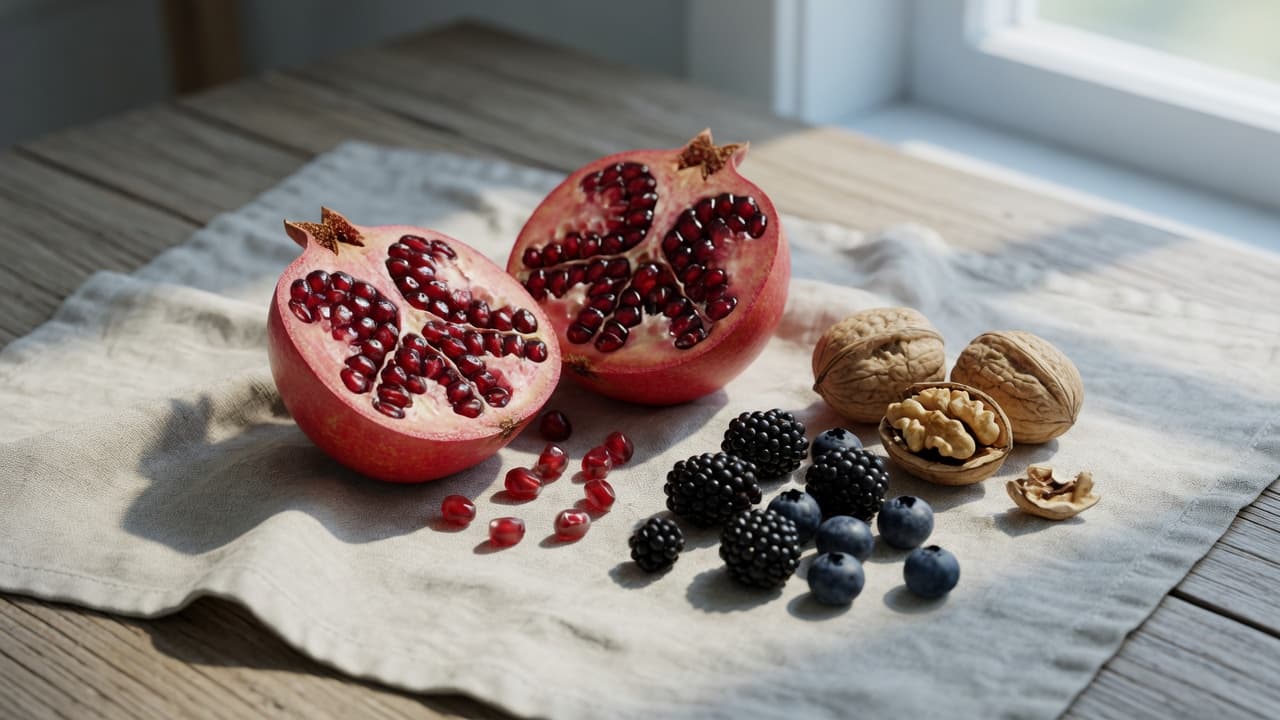
Urolithin A from pomegranate, walnut, and berry pathways improved heart relaxation in animals and engineered human tissue

Study (animal and engineered human tissue). Jie Su, Joseph R. Burgoyne, and colleagues at King's College London report in Science Advances (2026; 12(34); doi 10.1126/sciadv.aec8088; ScienceDaily 28 September 2026; British Heart Foundation funded). Urolithin A is made in the body after eating pomegranates, walnuts, and some berries. In models of heart failure with preserved ejection fraction — a stiff heart that still pumps but fills poorly — urolithin A activated PKGlα at a cysteine residue, improved relaxation measures by up to 80% versus untreated models, reduced scarring, and limited cell enlargement. Engineered human heart tissue from stem cells also relaxed more with urolithin A. Burgoyne said there is not enough evidence that people should eat pomegranates to treat this condition. James Leiper of the British Heart Foundation said clinical trials in people are still needed. Educational notes. This is not a food-as-cure claim.

Read at King's College London / Science Advances →Our summary♡ Save

  • 60+
  • Cardiovascular / lipids
  • Nutrition
  • Aging
  • study
  • aging

University College Cork / Nature Communications · 28 Sept 2026 · Nutrition

In 62 adults, stopping then restarting coffee shifted gut metabolites; decaf lined up with learning scores

Study (observational, small). Serena Boscaini, John F. Cryan, and colleagues at APC Microbiome Ireland, University College Cork, report in Nature Communications (2026; 17(1); doi 10.1038/s41467-026-71264-8; ScienceDaily 28 September 2026). They compared 31 people who usually drank 3 to 5 cups of coffee a day with 31 people who did not. Regular drinkers stopped coffee for two weeks, then restarted without knowing whether they received caffeinated or decaffeinated coffee. Stopping coffee shifted stool and urine metabolite profiles. After coffee returned, both groups reported lower perceived stress, depression, and impulsivity scores. Eggertella and Cryptobacterium curtum were more abundant in coffee drinkers. Improved learning and memory scores appeared only in the decaf arm; caffeinated coffee lined up with lower anxiety scores and better vigilance. The study was sponsored by the Institute for Scientific Information on Coffee. Sixty-two people cannot prove that coffee changes mood. Educational notes.

Read at University College Cork / Nature Communications →Our summary♡ Save

  • Cognitive / dementia research
  • Nutrition
  • study
  • gut
  • cognition

Université Sorbonne Paris Nord / EASD via Medical Xpress · 27 Sept 2026 · Nutrition

In a French cohort, the highest intake of a red-meat sugar tracked a 63% higher type 2 diabetes risk

Study (observational, preliminary). Leopold Fezeu of Université Sorbonne Paris Nord and colleagues presented an analysis of the NutriNet-Santé cohort at the EASD meeting in Milan (Medical Xpress 27 September 2026). Among 89,953 adults without diabetes or cancer at the start (average age 42; 79% women), dietary N-glycolylneuraminic acid (Neu5Gc) was estimated from three 24-hour food records. Humans do not make Neu5Gc. It is common in red meat, especially beef and lamb, and lower in dairy. Over a median 7.2 years, 966 people developed type 2 diabetes. The highest fifth of meat-derived Neu5Gc had a 63% higher risk than the lowest fifth after accounting for age, sex, activity, diet quality, smoking, and other conditions. The second-highest fifth had a 41% higher risk. The association was seen in men and in women. In the highest fifth, men ate a median 97 g of red meat a day (136 g including processed meat) and women 73 g (96 g including processed meat). After also accounting for total red meat, the Neu5Gc association weakened and was no longer statistically significant, so the sugar may explain part of the meat link, not all of it. Dairy-derived Neu5Gc was not associated with diabetes. The authors estimate obesity accounted for about 13% of the meat-derived association. Results are preliminary and not yet finalized. This is not proof that cutting beef prevents diabetes. Educational notes.

Read at Université Sorbonne Paris Nord / EASD via Medical Xpress →Our summary♡ Save

  • 40–59
  • Metabolic / glucose
  • Cancer
  • Nutrition
  • study

Frontiers in Aging · Added 25 Sept 2026 · Nutrition

Sex-specific effects of automated feeding on lifespan and reproduction in Nothobranchius furzeri

IntroductionNothobranchius furzeri, commonly known as African turquoise killifish, has emerged as a powerful model organism in diverse biological research areas owing to its exceptionally short lifespan of 4‐6 months. Dietary choices can significantly impact the physiology of this fish and its median longevity, prompting considerations on live versus dry food and feeding frequencies.MethodsHere, we present a novel, c

Read at Frontiers in Aging →Our summary♡ Save

  • Nutrition
  • Aging
  • Longevity
  • original research
  • aging
  • longevity

VitaLonga is an educational longevity resource, not a pharmacy, clinic, or doctor. Content is not medical advice and is not intended to diagnose, treat, cure, or prevent any disease (DSHEA). Supplements can interact with medications and are not appropriate in every pregnancy or health condition. Consult a licensed clinician, especially if you take medications, are pregnant or nursing, or have a diagnosed condition.