VitaLonga

Desk

News archive

Every story stays here. Filter by topic, search older headlines, and save favorites to your member record. Educational notes only — not medical advice.

Saved (sign in)

101 stories in this category

Penn State / Proceedings of the Royal Society B · 19 Oct 2026 · Exercise

In 12 growing guinea fowl, a leg weight worn from youth removed the extra energy cost of carrying it as adults

Study (guinea fowl, not people). Talayah A. Johnson, Kavya Katugam-Dechene, Jonas Rubenson, and colleagues at Penn State report in Proceedings of the Royal Society B (2026; 293(2074); DOI 10.1098/rspb.2026.0199). ScienceDaily ran it on 14 Oct 2026. Twelve birds were followed from 2 weeks to 16 weeks. Six wore a lead band on one leg equal to 4 percent of body weight. Six did not. At 16 weeks, birds that had never worn the band used 23 percent more energy walking with the load than without it. Birds that grew up with the band used no extra energy to carry it, and on average used no more energy with the band than the untrained birds used walking unloaded. Standing energy did not differ. This is not evidence that a weighted childhood makes human exercise easy. Not medical advice.

Read at Penn State / Proceedings of the Royal Society B →♡ Save

  • Exercise
  • development
  • animal
  • fitness
  • study

GeroScience · 19 Oct 2026 · Exercise

In 82 older adults who kept cycling for nine years, peak aerobic capacity still fell about 20 percent

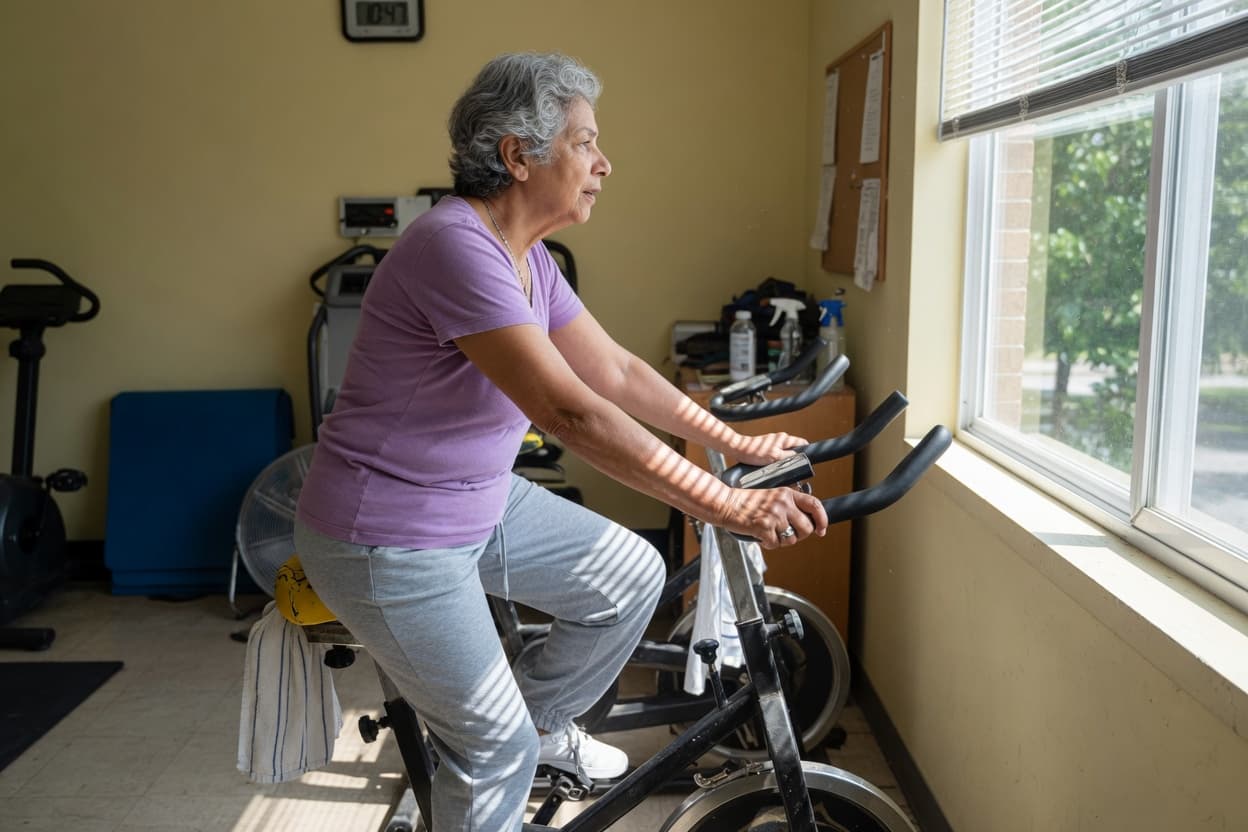
Study (longitudinal). Amir S. Fathi, Stephen D. R. Harridge, and colleagues report in GeroScience (2026; DOI 10.1007/s11357-026-02483-6). The public summary attached to a 14 Oct 2026 ScienceDaily brief says 82 older adults who kept cycling were followed for nine years. Peak aerobic capacity fell 19.7 percent on average. Among those who finished the exercise test, nearly all scored at or above the 90th percentile for their age. The summary does not give the sex split or the exact ages. Regular cycling did not freeze aerobic capacity. Not medical advice.

Read at GeroScience →♡ Save

  • 60+
  • Exercise
  • Aging
  • cycling
  • aerobic
  • older-adults
  • aging
  • fitness
  • study

Karolinska Institutet / Journal of Cachexia, Sarcopenia and Muscle · 19 Oct 2026 · Exercise

In 427 Swedish adults followed from age 16 to 63, fitness and strength started falling around age 35

Study (longitudinal cohort). Maria Westerståhl and colleagues at Karolinska Institutet report in the Journal of Cachexia, Sarcopenia and Muscle (2025; 16(6); DOI 10.1002/jcsm.70134). ScienceDaily recirculated the paper on 14 Oct 2026. The Swedish Physical Activity and Fitness study followed 427 men and women born in 1958, with tests from age 16 through 63. Aerobic fitness and muscular endurance were highest between ages 26 and 36. Performance began to decline around the mid-30s, and explosive muscle power peaked earlier. By age 63, average performance was about 30 to 48 percent below peak. The pattern was similar in men and women. People who became active in adulthood gained about 5 to 10 percent in physical capacity. Activity slowed the drop and did not stop it. A 2026 follow-up in Scientific Reports (DOI 10.1038/s41598-026-52389-8) found that better aerobic fitness at ages 34 and 52 lined up with less arterial stiffness at 63, after accounting for obesity, smoking, and blood pressure. That link is not proof that fitness prevented stiff arteries. Not medical advice.

Read at Karolinska Institutet / Journal of Cachexia, Sarcopenia and Muscle →♡ Save

  • Under 40
  • 40–59
  • 60+
  • Cardiovascular / lipids
  • Metabolic / glucose
  • Exercise
  • fitness
  • cohort
  • strength
  • study

UNICAMP / Life Sciences · 18 Oct 2026 · Exercise

In obese male mice, seven strength sessions shrank visceral fat cells without a change in body weight

Study (male mice). Diego Gomes de Melo, Leandro Pereira de Moura, and colleagues at the State University of Campinas report in Life Sciences (2026; 401:124546; DOI 10.1016/j.lfs.2026.124546). Obese mice fed a high-fat diet either stayed sedentary or climbed a 70-centimeter stair 20 times a session, at about 70 percent of the load they could carry, with 60 to 90 seconds of rest, for seven sessions. Both groups kept the high-fat diet. Body weight did not fall. The trained mice had less mesenteric fat around the intestine and smaller fat cells. Markers of fat breakdown, including the ABHD5–ATGL interaction and perilipin-1, moved toward more lipolysis, and Scd1 expression was lower. Only male mice and one fat depot were studied. This is not evidence that one week of lifting shrinks belly fat in people. Not medical advice.

Read at UNICAMP / Life Sciences →♡ Save

  • Metabolic / glucose
  • Exercise
  • Nutrition
  • strength
  • fat
  • mice
  • nutrition
  • study

University of Texas at Austin / Journal of Physical Activity and Health · 18 Oct 2026 · Exercise

In University of Texas students wearing trackers, more frequent activity lined up with more deep sleep

Study (observational, wearable trackers). Christian J. Corral, Benjamin Baird, and colleagues at the University of Texas at Austin report in the Journal of Physical Activity and Health (2025; 22(8):1042; DOI 10.1123/jpah.2024-0844). ScienceDaily recirculated it on 11 Oct 2026. Students wore Fitbits for several months. People active on more days spent more time in non-REM sleep, including deep sleep. Among these young adults, about 10 minutes a day of moderate-to-vigorous activity lined up with better sleep. Walking and standing breaks lined up with healthier sleep and a better next-day mood. More non-REM sleep lined up with better next-day energy and less stress. The design cannot show that activity caused the sleep change. The sample is university students, not older adults. Not medical advice.

Read at University of Texas at Austin / Journal of Physical Activity and Health →♡ Save

  • Under 40
  • Exercise
  • Aging
  • sleep
  • activity
  • students
  • aging
  • study

Duke-NUS / PNAS · 18 Oct 2026 · Exercise

In flies and aging mice, exercise lowered DEAF1 and rebalanced a growth signal tied to muscle repair

Study (fruit flies and mice). Sze Mun Choy, Hong-Wen Tang, and colleagues at Duke-NUS Medical School, with Singapore General Hospital and Cardiff University, report in PNAS (24 Nov 2025; DOI 10.1073/pnas.2508893122). Science outlets recirculated the paper on 15 Oct 2026. DEAF1 rose in aging muscle, increased mTOR transcription, and left the growth complex mTORC1 overactive, with worse turnover of damaged proteins. Exercise lowered Deaf1 through FOXO. Blocking FOXO, or forcing DEAF1 higher, blocked those exercise effects in the animals. Raising DEAF1 weakened muscle; lowering it improved the balance of building and cleanup. This is not a human treatment and does not prove the same switch explains muscle loss in people. Not medical advice.

Read at Duke-NUS / PNAS →♡ Save

  • Exercise
  • Aging
  • muscle
  • animal
  • aging
  • fitness
  • study

ScienceDaily · 17 Oct 2026 · Exercise

Scientists discover how deep sleep builds muscle, burns fat, and boosts the brain

Scientists have discovered a surprising two-way relationship between sleep and growth hormone, revealing how the brain carefully balances physical recovery with wakefulness. The findings could help explain why poor sleep harms metabolism and brain health, potentially opening the door to new treatments for sleep and neurological disorders.

Read at ScienceDaily →♡ Save

  • Metabolic / glucose
  • Cognitive / dementia research
  • Exercise
  • sleep
  • muscle
  • cognition

Karolinska Institutet / Scientific Reports · 16 Oct 2026 · Exercise

In Swedes followed from age 16 to 63, better aerobic capacity at 34 and 52 lined up with less stiff arteries at 63

Study (longitudinal cohort). Maria Westerståhl and colleagues at Karolinska Institutet followed 427 men and women born in 1958 in the Swedish Physical Activity and Fitness study. A 2026 paper in Scientific Reports (DOI 10.1038/s41598-026-52389-8) found that people with better aerobic capacity at ages 34 and 52 tended to have less arterial stiffness at 63, and the link remained after accounting for obesity, smoking, and blood pressure. It does not prove that fitness prevented the vessel change. The same group's 2025 capacity paper (DOI 10.1002/jcsm.70134) reported that aerobic fitness and muscular endurance peaked between about 26 and 36, performance began to slip in the mid-30s, and by 63 the average drop from peak was about 30 to 48 percent. People who became active in adulthood gained about 5 to 10 percent in capacity. Decline rates were similar in men and women. Not medical advice.

Read at Karolinska Institutet / Scientific Reports →♡ Save

  • Under 40
  • 40–59
  • 60+
  • Cardiovascular / lipids
  • Metabolic / glucose
  • Exercise
  • fitness
  • arteries
  • cohort
  • study

ScienceDaily · 16 Oct 2026 · Exercise

Scientists discover how exercise reverses muscle aging

Scientists have uncovered a hidden biological mechanism that helps explain how exercise can reverse some of the damage caused by muscle aging. The key is a gene called DEAF1, which becomes overactive with age and interferes with the muscles’ ability to clear damaged proteins and repair themselves. Exercise can help restore this balance, allowing older muscles to rebuild and regain strength, although the benefits may

Read at ScienceDaily →♡ Save

  • Exercise
  • Aging
  • muscle
  • aging
  • fitness

BMC Geriatrics · 16 Oct 2026 · Exercise

Twelve weeks of resistance sessions tracked with mood and thinking scores in frail older adults

BMC Geriatrics published on 16 October 2026 a secondary look at the TEAMS trial. 295 community-dwelling older adults (mean age 74, 69 percent women) did twice-weekly resistance training for 12 weeks, with or without a higher-protein eating plan. Depressive symptoms fell, cognitive test scores improved, and a quality-of-life score rose, with no consistent difference by how heavy the loads were. The eating plan was tied to less fear of falling and little else. The sample includes men, so it is not a women-only result. Not medical advice.

Read at BMC Geriatrics →♡ Save

  • 60+
  • Cognitive / dementia research
  • Exercise
  • Nutrition
  • Aging
  • study
  • cognition
  • fitness
  • aging

ACSM · 15 Oct 2026 · Exercise

Nutrition Guide for Senior Athletes

Why Nutrition Needs Change With Age Macronutrients are the nutrients that provide the body with energy: protein, carbohydrate and fat. Getting the right amounts supports training, recovery and muscle health. The table below shows the daily recommended amounts of each for active older adults. Macronutrients Nutrient Daily Recommended Amount Notes Protein 1.0 to 1.2 g/kg […] The post Nutrition Guide for Senior At

Read at ACSM →♡ Save

  • 60+
  • Exercise
  • Nutrition
  • Aging
  • aging adult
  • nutrition
  • rehabilitation & recovery
  • nutrition for recovery
  • nutrition for senior athletes
  • senior athlete
  • aging
  • fitness

ScienceDaily · 14 Oct 2026 · Exercise

A 47-year study found fitness starting to fall around age 35

ScienceDaily reported on 14 October 2026 a Karolinska Institutet follow-up of the Swedish Physical Activity and Fitness study, published in the Journal of Cachexia, Sarcopenia and Muscle. The same 427 men and women, born in 1958, were measured from age 16 to 63. Aerobic fitness and muscular endurance generally peaked between 26 and 36, and average performance was about 30 to 48 percent below peak by age 63. Decline rates were similar in men and women. People who became active in adulthood gained about 5 to 10 percent in physical capacity, but activity did not erase the age pattern. A 2026 Scientific Reports paper on the same cohort linked better aerobic fitness at 34 and 52 with less arterial stiffness at 63, after accounting for obesity, smoking, and blood pressure. That link is not proof of cause. Not medical advice.

Read at ScienceDaily →♡ Save

  • Cardiovascular / lipids
  • Metabolic / glucose
  • Exercise
  • study
  • fitness

VitaLonga is an educational longevity resource, not a pharmacy, clinic, or doctor. Content is not medical advice and is not intended to diagnose, treat, cure, or prevent any disease (DSHEA). Supplements can interact with medications and are not appropriate in every pregnancy or health condition. Consult a licensed clinician, especially if you take medications, are pregnant or nursing, or have a diagnosed condition.